
Posted
08/07/2026
Author
Rory Chatterton
Best practice is usually what's easiest to sell.
We should probably start treating AI research on best practice with the same scepticism we give Best Place to Work awards.
Nobody believes that award measures workplaces. What it measures is who entered, who paid, and who had HR with a spare fortnight. It certainly says something.
So when Google releases DESIGN.md, or SDD arrives as the new hotness as if BDD never happened, don't ask whether it's right. Ask what it's a signal of. Somebody spent money making this legible to you, and the spending tells you what they wanted, which was almost never your architecture.
Meanwhile the people who could tell you how this actually goes have often have written nothing. No incentive, no permission, no time. Most of the best engineers I've met have no presence whatsoever.
And that's the whole problem, really. There are just more people writing confidently wrong things than carefully right ones. Always have been. Confidence is cheap and being right is expensive, so the ratio was never going to be good.
What's new is we've built something that reads all of it and weights by how often it turns up. And here the award analogy runs out, because the machine adds a second failure the award never had.
The award is rigged by who enters. The model is rigged by who repeats.
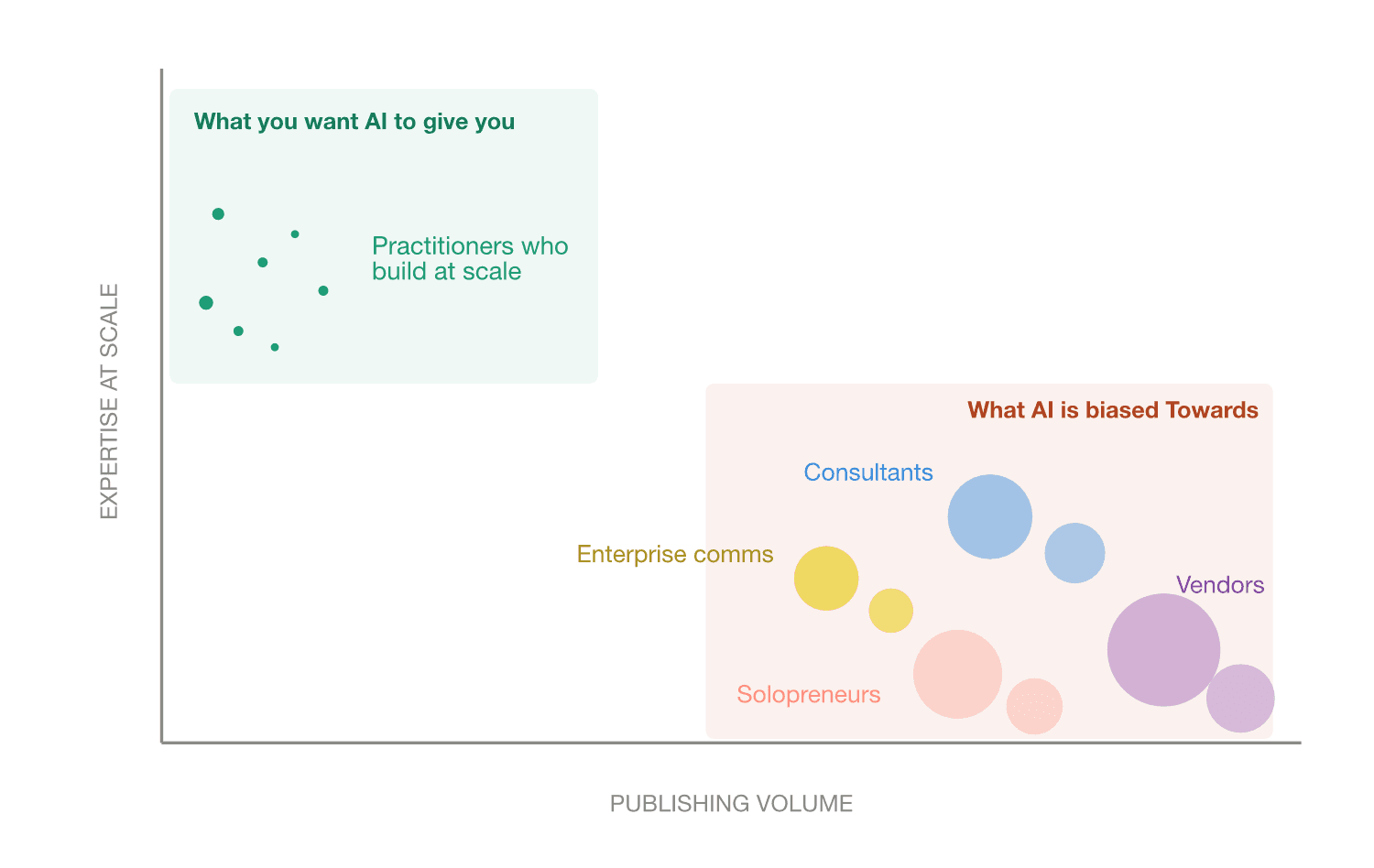
It doesn't hand you the best answer any more than the charts hand you the best song, it hands you the most-played one. Those were never the same thing. Worse, it does the weighting on a corpus already filtered for who had the time to write, so you get frequency stacked on selection bias: the most common voice, drawn from the pool of people who were going to write anyway. We just never had a machine that made the gap so obvious.
And when the people who do know finally write something, look at what forces their hand. The pitch, pushed by vendors, then parroted at scale by people well outside the design sphere, was that WEB DESIGN IS DEAD WITH THESE 3 PROMPTS, and that a design system now collapses into a single markdown file a model can read and reproduce from.
Atlassian actually run one of these design systems at scale, so they took the claim at its word: they benchmarked their design system against the markdown file and published what they found. It solves a smaller, different problem than the one they have. A team who understand something almost nobody else does, spending their one shot not to advance an idea but to correct a narrative written by people who don't do the work, explaining why a thing built for a different problem doesn't solve theirs.
Then read the comments, where there's people discussing Atlassian's approach to design being a single markdown file and missing the point.
Writing well used to be hard, so we assumed anyone writing well knew what they were on about. Fair enough. It stopped being hard about three years ago.